
China Governance Lab > Graduate Fellows > Book Reviews
Book Review
Waiting to Be Arrested at Night
A Uyghur Poet’s Memoir of China’s Genocide
Author: Tahir Hamut Izgil
Review by Ted Allen-Rawding
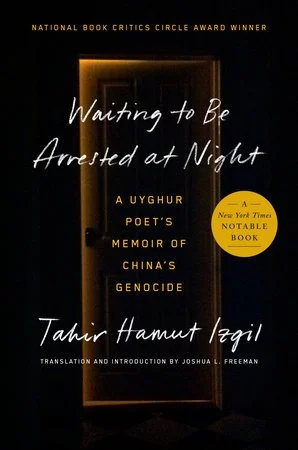
In Waiting to Be Arrested at Night, celebrated Uyghur poet, writer, and filmmaker Tahir Hamut Izgil offers an autobiographical account of repression in Xinjiang, and his ultimate flight into exile abroad in 2017. The memoir documents how daily life in Xinjiang was transformed through mechanisms of state securitization, surveillance, ambiguity, and fear. Through intimate reflections on family life, friendship, artistic community, and social interaction, Hamut illustrates how repression operates not only through direct coercion, but through the gradual infiltration of uncertainty and fear into daily life and interpersonal relationships.
In doing so, the memoir provides insight into both the individual and collective tragedies of repression in Xinjiang, capturing the consequences of authoritarian governance. The processes Izgil illustrates speak to broader global concerns intersecting human rights and modern authoritarianism, including the expansion of surveillance technologies, data collection, and new invasive forms state control.
Waiting to Be Arrested at Night thus stands as an important primary source for scholars researching contemporary China and Xinjiang, as well as for those interested in surveillance, digital authoritarianism, and the lived experiences of modern state repression more broadly.
1. Waiting to Be Arrested at Night reads not only as a personal memoir, but as a detailed account of how repression operates in everyday life -through uncertainty, anticipation, and seemingly mundane interactions. In writing the book, was your focus more on making sense of your own experiences, or on conveying what was happening around you to readers who might otherwise never see it? How did that shape the story you chose to tell?
Izgil: When writing this memoir, “understanding and processing my own experiences” and “bearing witness to the world” were never separate endeavors. They were two sides of the same act. Piecing together memories shattered by fear and suffocation became, for me, a deeply personal form of spiritual recovery. At the same time, I felt a strong sense of survivor’s responsibility. Political reports and statistics can document atrocities, but they cannot fully convey the lived texture of fear.
That understanding guided my choice of details. I deliberately avoided dramatic or grand narratives and focused instead on the quiet erosion of ordinary life. I wrote about the sudden silences between friends on the phone, the coded glances exchanged between husbands and wives, and the terror triggered by a knock on the door late at night. I wanted readers to understand that catastrophe does not descend all at once. It advances gradually, step by step, until fear becomes woven into daily routines and even the smallest human interactions begin to feel dangerous.
2. The memoir presents “waiting” as a condition of anticipating an uncertain fate, both individually and collectively. How did this indeterminacy -never knowing what might happen, or to whom- shape how people navigated everyday life?
Izgil: This constant, unpredictable “waiting” became a form of psychological attrition. When uncertainty turns into the normal condition of life, people begin to reshape themselves around fear.
To protect their families and friends, many people started cutting off long-standing relationships on their own. They stopped expressing genuine thoughts, even in private conversations. Ordinary interactions became tense and guarded. People learned to measure danger in everyday moments — a phone call, a visitor at the door, a child repeating something heard at home.
Over time, people stopped imagining a distant future. Life narrowed into a single goal: getting through today safely. The fear of “not knowing who would be next” isolated people from one another and quietly entered the most intimate parts of daily life — family dinners, conversations between spouses, even brief greetings between neighbors.
3. You recount an earlier experience of detention decades prior to the period described in the book and suggest that what followed was not simply an iteration of earlier forms of repression -but a qualitatively different form of it. From your perspective, what changed? Was it a matter of scale, intensity, technology, or something more structural in how state control is exercised in Xinjiang?
Izgil: When I was detained decades ago, the repression still resembled a more traditional political campaign. It targeted certain individuals or groups for limited periods of time. What emerged later was fundamentally different.
The change was not only about larger scale, more advanced surveillance technology, or harsher punishment. The system itself became continuous and total. State control no longer focused only on what you did. Simply being Uyghur, having relatives abroad, praying regularly, or behaving “abnormally” could place your entire life under suspicion.
Surveillance extended beyond public behavior into family relationships, private thoughts, and everyday habits. The goal was no longer simply to punish “violators,” but to reshape an entire population psychologically and culturally. What frightened me most was that this control became invisible and permanent — not a temporary political campaign, but a condition of life itself.
4. Throughout the memoir, many of the people you encounter -police, officials, neighborhood figures- appear as complex individuals rather than faceless agents of control and repression. How did you understand their role at the time? To what extent did you see them as constrained by larger structures, versus active participants in enforcing that system?
Izgil: When I encountered policemen, local officials, or neighborhood authorities, I often sensed deep internal contradictions within them. Many were themselves trapped inside the same machinery of fear. Through punishments, evaluations, and collective responsibility, the system made obedience a condition of survival. If they failed to carry out orders, they and their families could themselves become targets.
At the same time, the line between passive obedience and active participation was often difficult to separate. The system rewarded displays of loyalty and severity, and some individuals embraced cruelty to protect themselves or advance their own position. Others, however, still managed to preserve fragments of humanity — sometimes through a brief glance, a softened tone of voice, or a quiet decision not to pursue something further.
I wanted to write about this complexity not to excuse the oppressors, but to show one of the system’s cruelest features: it not only destroys the victims, but also gradually distorts the humanity of those who enforce it.
5. Your memoir has received wide international acclaim and is often framed within broader discussions of surveillance, authoritarian governance, and human rights. What do you most hope readers, particularly those outside China, take away from your account?
Izgil: My hope is that readers outside China will understand that this is not a distant dystopian story or an abstract geopolitical issue. It is a human tragedy unfolding in the modern world, affecting ordinary people and ordinary families.
At the same time, I hope readers recognize that the logic behind mass surveillance, technological control, and the systematic erosion of human rights is not confined to one region alone. When modern technology becomes aligned with unchecked power, freedom and dignity can disappear gradually, almost invisibly, through the routines of everyday life.
Beyond witnessing the suffering and resilience of the Uyghur people, I hope the book encourages readers to reflect on how fragile freedom can become when fear is normalized and surveillance becomes embedded in daily existence.
Featured Author
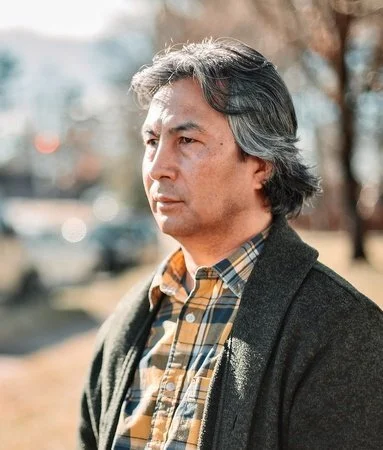
Tahir Hamut Izgil
Tahir Hamut Izgil is one of the foremost poets writing in Uyghur. He grew up in Kashgar, attended college in Beijing, and worked as a film director in the Uyghur region. His memoir, Waiting to Be Arrested at Night: A Uyghur Poet’s Memoir of China’s Genocide (published in 2023), has garnered significant international acclaim, winning the NBCC John Leonard Prize for Best First Book and the Moore Prize for Human Rights Writing. It was named one of the Best Books of 2023 by The New York Times, The Washington Post, The Economist, and TIME.