
China Governance Lab > Graduate Fellows > Book Review
Book Review
The Authoritarian Commons: Neighborhood Democratization in Urban China
Author: Shitong Qiao
Review by Mary Hertz
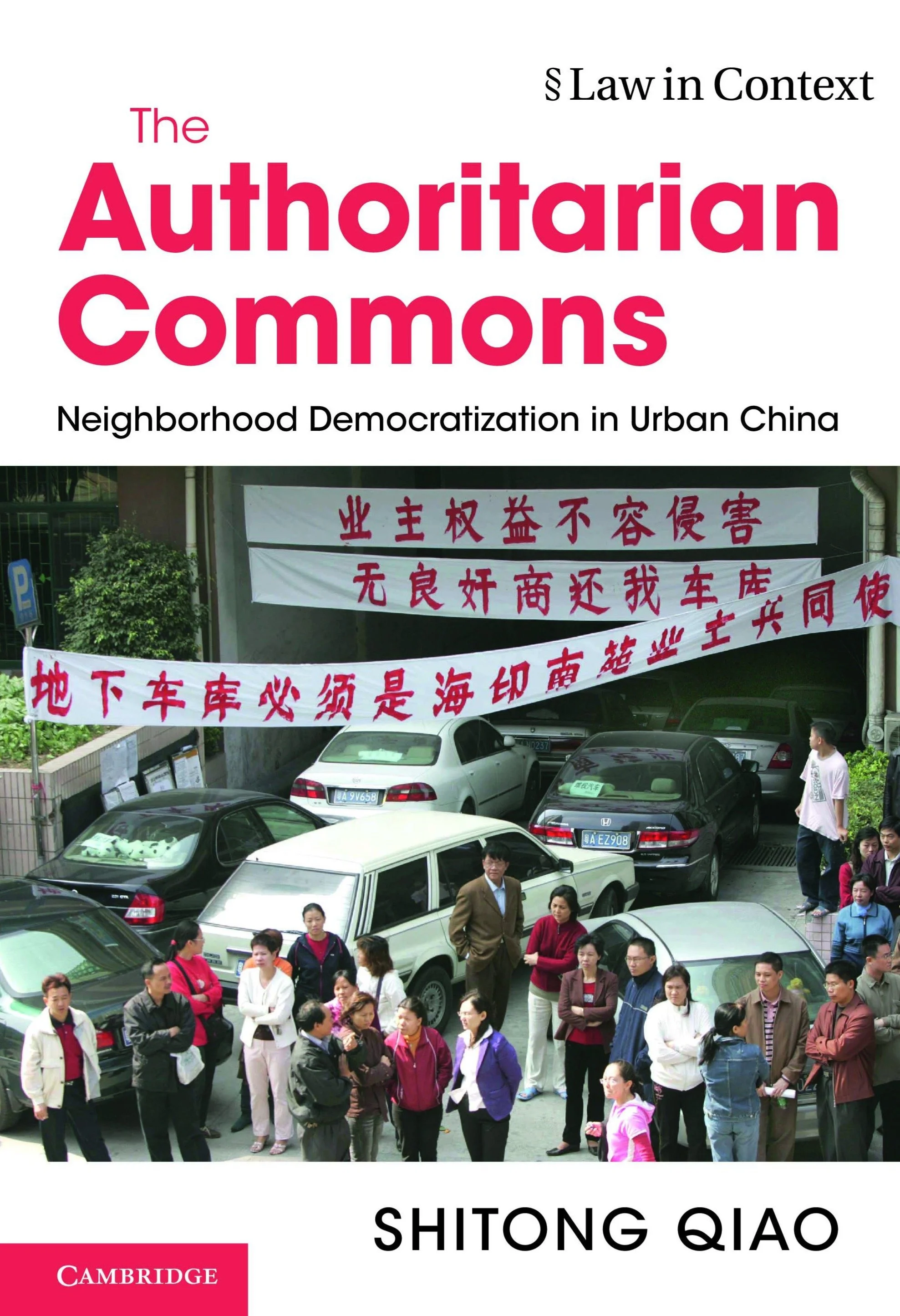
The Authoritarian Commons examines how neighborhood self-governance can emerge and function inside an authoritarian regime. Authoritarian commons—exemplified by China’s condominium neighborhoods, where homeowners hold individual units alongside joint rights in shared spaces and thus must collectively govern through homeowners’ associations (HoAs)—sit at the heart of the book’s argument. Drawing on both quantitative and qualitative data, the book argues that China’s “authoritarian commons” are not an oxymoron: condominium neighborhoods become sites where the party-state both enables and constrains homeowner self-governance, legalizing HoAs while reserving political and legal means to shape and contain them. The book begins with the rise of condominium ownership and the spread of HoAs, which institutionalize democratic procedures for managing common property. It defines neighborhood democratization as homeowners wresting control from developers and management companies. But it shows this struggle is constrained by a core authoritarian dilemma—while total state control risks poor service delivery and legitimacy loss, genuine delegation risks independent organization and mobilization. This book argues that the overlapping of interests between the government and homeowners, which often results in cooperation between the two sides, provides a foundation for homeowner resistance to authoritarian control, protecting material property interests while sustaining the pursuit of democracy.
1. Your research spans property rights, legal housing, and the Chinese political regime. What drew you to focus specifically on neighborhood democratization?
The first reason is that I have long been interested in governance problems—specifically, the governance of common resources—which is a core focus of this book.
The second reason is more personal. After I finished my first book, Chinese Small Property: The Co-Evolution of Law and Social Norms, published in late 2017, I started thinking about what to do next. Partly by chance, I noticed that my classmates from Peking University—many of them legal professionals, some working for the government, and generally typical middle-class people—were complaining about property management in their neighborhoods and advocating for the establishment of homeowners’ associations (HoAs) on the popular social media platform, WeChat. They were advocating not only in their own communities but also in others.
I found this fascinating because these Peking University Law School graduates were not human rights activists. They were busy middle-class professionals, and many worked for the government. Yet when it came to property management and neighborhood governance, they behaved like activists—asserting rights, talking about mobilization, and criticizing government performance. What’s most striking to me is the amount of time they devoted to something not directly related to their jobs. In China, people are often focused on making money or getting promoted, so sustained volunteering around communal or public affairs is not something you see every day.
I was genuinely puzzled: Why were they doing this? Given my training in law and political economy, I first considered their economic incentives, but there did not seem to be much direct economic payoff. That question is what got me started—trying to understand why not just one person, but multiple individuals, even within a small group, were acting this way. It also challenged my prior assumptions about how China’s middle class thinks and behaves toward the government and toward their community.
2. In your book, you drew heavily on interviews with neighborhood activists, legal professionals, and government officials as empirical evidence. Your interviews were conducted in various Chinese cities across different political environments, including the period following the COVID-19 pandemic. Could you discuss the primary methodological and practical challenges you encounter—particularly given the increasing difficulty of conducting fieldwork in China—and elaborate on how you address them?
The Authoritarian Commons is an ethnographic description of HoAs and neighborhood democratization in China. Overall, there are two major challenges of my fieldwork in China.
The first is getting into the field: meeting people and getting them to talk to you. When I conducted fieldwork for my first book, the first months yielded very little because I was not yet in the network. Building trust to get people to talk to you—and treat you as one of them—takes a lot of work.
At the same time, conducting interviews for my first book helped me build a network; consequently, many people were willing to speak with me during my fieldwork in 2018–2019. It still took effort—attending meetings and lunches, being tenacious, and getting introduced by trusted contacts—but once they trusted you, they would talk for hours, in person or by phone. Methodologically, there is nothing mystical: you have to do the work.
The second challenge is political sensitivity. I was lucky. Despite the sensitivity of some parts of my research, such as pandemic governance, I was still able to conduct the ethnographic research because most of the work was completed in 2018–2019, and I was already part of the network of homeowner activists. People trusted me and were willing to speak with me because of my prior work. Otherwise, I cannot imagine writing the chapter on “cooperating to resist.” I hesitated initially, but I felt obligated because I had a unique perspective. If I did not write it, I was not sure anyone else could write it the way I could.
That said, neighborhood governance is generally not considered a sensitive topic in China. Property management is a major concern for many middle-class homeowners, and many people want to talk about it—even government officials.
3. How do you expect the relationship between HoAs and the government to evolve? Do you foresee greater institutionalization of these associations or tighter state oversight?
First, HoAs are needed more than ever. After the commercialization of housing reform began in 1998, a wave of HoA activism emerged in the early 2000s. But the demand for effective governance is even more urgent now, given the age of many buildings and their growing maintenance needs.
Second, business models of property management in China have shifted in recent years. Developers often operate property management companies, and as property development slows, property management as a business becomes more important to them. As a result, disputes and governance problems tend to be more severe now than before.
There was a fundamental shift in the way the government approached the issue of property management in 2017. Prior to that, property management was largely treated as a technical issue, not a top leadership agenda item. But in 2017, for the first time in the history of the PRC, the CCP Central Committee and the State Council jointly issued a document on neighborhood governance and explicitly mentioned HoAs, bringing the issue onto the top leadership agenda. The state needs HoAs because it can no longer do the job of addressing conflicts regarding property management on its own. With the economic downturn and tighter local government finances, the government relies more than ever on homeowners to provide governance and services in their own neighborhoods.
At the same time, the state wants to regulate HoAs to prevent them from “going too wild.” One measure is to establish party branches within HoAs, which is part of broader party-building efforts observed in the operations of transnational firms in China. Carrefour is an oft-cited example. Many assume these efforts succeed, but my research, based on interviews and ethnographic work, suggests the picture is more mixed.
So, how will the relationship between the state and HoAs evolve? I think the party would say, “We want to support HoAs, but we also want to make sure HoAs are under firm leadership of the party.” I am skeptical how much effective control the party can actually exercise over HoAs because they have independent agendas and resources. They are not government-funded; they control property management fees and common-area maintenance decisions. When homeowners’ interests overlap with those of the government, there is real room for cooperation. But when the government tries to encroach on homeowners’ rights and interests, homeowners consistently resist. I expect this dynamic of cooperation and resistance to persist into the future.
4. To what extent do you think your findings on the dynamics of “cooperating to resist” and the tendency toward neighborhood democratization are generalizable to other regions in China or even to other authoritarian countries?
I believe the paradigm I developed—“the authoritarian commons” and the “cooperating to resist” dynamic—should be applicable to other contexts. It could apply not only to other authoritarian contexts but might also to liberal democracies—for example, the United States. This logic of resistance from inside, in retrospect, is pretty common. For example, public law scholars such as Heather Gerken and Jessica Bulman-Pozen have long argued that we shouldn’t understand federalism as protecting state and local affairs from the encroachment by the federal government; instead, state and local governments should engage with the federal government and resist its abuse of power from inside.
This book also defines the conditions for successful neighborhood democratization, namely, a strong state, a strong society, and the rule of law. I suspect that these conditions are also what democratization in other contexts requires.
Featured Author
Shitong Qiao
Shitong Qiao is the Ken Young-Gak Yun and Jinah Park Yun Distinguished Professor of Law at Duke, where he teaches Property and Comparative Law. He is also the author of Chinese Small Property (2017) and a number of journal articles. He is primarily interested in whether and how the law works.